
When someone dies, the freezer fills up. People arrive with lasagne and banana bread and…

Adjusting to Expat Life in the UAE: A Psychologist’s Reflections
By Christi Gadd · Clinical Psychologist & Neuropsychologist · HPCSA PS 0116947 · DHA 73418869 · Dubai via Thrive Wellbeing Centre, JLT.
Moving to a new country is one of those life events that looks exciting on the outside and feels unruly on the inside. In a recent conversation on the Thrive With Us podcast, I sat down with Dr Sarah Rasmi to talk about expat adjustment — what I’ve noticed in my own back-and-forth between Dubai and South Africa, and what comes up in the consulting room with clients making their own transitions. This piece is a companion to that conversation for people who’d rather read than listen, and for those who want something to come back to.
The emotional weather of a move
The standard narrative says moving abroad is exciting. It is — and that’s often the part that makes it confusing. Excitement doesn’t protect you from grief, disorientation, or the strange flatness that arrives once the admin is done and the flat is unpacked. Most of the expats I see clinically are caught off-guard by the fact that they feel worse at three months than at three weeks. That is not a failure of adjustment. It is the predictable shape of it.
A move at this scale asks a lot of you all at once. You are taking in enormous amounts of novelty while also acting as if nothing is strange. You’re expected to function at work, socialise, and make decisions, while quietly noticing new sounds, new faces, new heat, new traffic patterns, a new currency. Fatigue, in this context, is not weakness. It is accurate.
Who you were, and who you’re becoming
The second layer — less talked about — is identity. Much of who we are is scaffolded by context: the friends who know our history, the routines that shape our days, the competencies we’ve spent years building. Relocate, and a lot of that scaffolding comes down at once.
For some people this feels liberating. For others it feels like a small, specific grief for the version of themselves they were before. Both responses are normal, and the same person can hold both in a single week. Most of the people I see do better when they’re allowed to hold the grief alongside the excitement, rather than asked to pick one story about the move.
The partner who moved for someone else’s job
One of the patterns I see most consistently in Dubai is the struggle of the trailing partner — the spouse or partner who has moved for someone else’s career. On the surface, they are often the person least defended: they have been given a lifestyle, time, perhaps help at home. But the move has cost them their professional identity, their support network, and their sense of pace. Their grief is real, and it is often invisible to the people around them — including their partner. (This is one of the reasons it shows up so often in couples therapy.)
If you are the working partner, the most useful thing you can offer is not a solution. It is an acknowledgement that what looks like a privilege from the outside is a significant psychological adjustment from the inside. If you are the trailing partner, resist the instinct to minimise what you’re carrying. Boredom, identity loss, and relational strain are not signs that you are ungrateful. They are signs that something real is happening, and it deserves attention.
Building connection without faking it
Dubai is, famously, transient. People arrive, people leave. The pace of friendship here is faster than what many of us grew up with, and that can be wonderful and exhausting in equal measure. The temptation is either to sprint into as many communities as possible or to opt out of community altogether. Neither tends to hold up over time.
What does hold up, in my experience, is something much less social-media friendly: a small number of relationships you tend to deliberately. One or two people with whom you are willing to be honest about how the move is actually going. A regular rhythm of contact with people at home, on a schedule you don’t negotiate away. A community — religious, professional, creative, sporting — that you show up to even on the days you don’t want to. Connection in an expat context is much less about meeting people than it is about staying.
When to reach for professional support
Most expat adjustment is not a clinical problem. It is a human one, and time, community, and a bit of self-kindness handle a lot of it. But there is a smaller set of issues that don’t resolve with time alone and that benefit from professional support: persistent low mood, anxiety that interferes with daily functioning, relationship ruptures that are widening rather than closing, and the particular grief of a move that has layered on top of earlier, unprocessed losses.
If you are noticing any of these, it is worth speaking with a psychologist who works with expats specifically. The nuance of a move — cultural, relational, administrative — matters in the therapy room, and a clinician who understands it can save you months of trying to explain the context before you can get to the work. Where in-person sessions aren’t practical, online therapy is a reasonable alternative for clients across the UAE.
A closing thought
Adjusting to expat life in the UAE is not something you finish; it is something you get better at noticing. The version of you that walks off the plane is not the version that walks out of the year. Let both be real.
Listen to the full conversation
Episode: Moving to the UAE: What Expats Need to Know on the Thrive With Us podcast, hosted by Dr Sarah Rasmi.
How to book with me
Working with expats through the adjustment period is a specific interest of mine, alongside couples and sex therapy. I see clients in Dubai through Thrive Wellbeing Centre in JLT, and online for people based elsewhere. If any of this piece resonated and you’d like to work together, you can get in touch via reception@thrive.ae
Frequently asked questions
How long does it take to adjust to expat life in the UAE?
Most people I see clinically describe a noticeable dip around the three-month mark, after the practical admin of moving has settled. That isn’t a sign that the move was wrong — it’s the predictable shape of adjustment. The first six to twelve months tend to involve waves rather than a steady upward curve.
What is the “trailing spouse” effect, and how do I manage it?
The trailing spouse — the partner who has moved for someone else’s career — often carries the most invisible struggle of the move. Lifestyle gains can mask significant losses in professional identity, support network, and pace of life. The most useful first step is to name what’s been lost rather than minimise it, and to seek support that takes the relational and identity layers seriously.
When should I consider seeing a psychologist about expat adjustment?
Most adjustment is not a clinical issue. But if you notice persistent low mood, anxiety that interferes with daily functioning, relationship ruptures that are widening rather than closing, or a move that has layered on top of earlier unprocessed losses, those are reasons to speak with a psychologist who works with expats specifically.
Where can I see Christi Gadd for expat-related therapy?
I see clients in Dubai through Thrive Wellbeing Centre in JLT, and online for clients elsewhere across the UAE and internationally. You can get in touch through:
Find us at Thrive Wellbeing Centre for bookings:
 https://www.thrive.ae
reception@thrive.ae
+971 56 895 2347
+971 4 514 7386


Related Posts
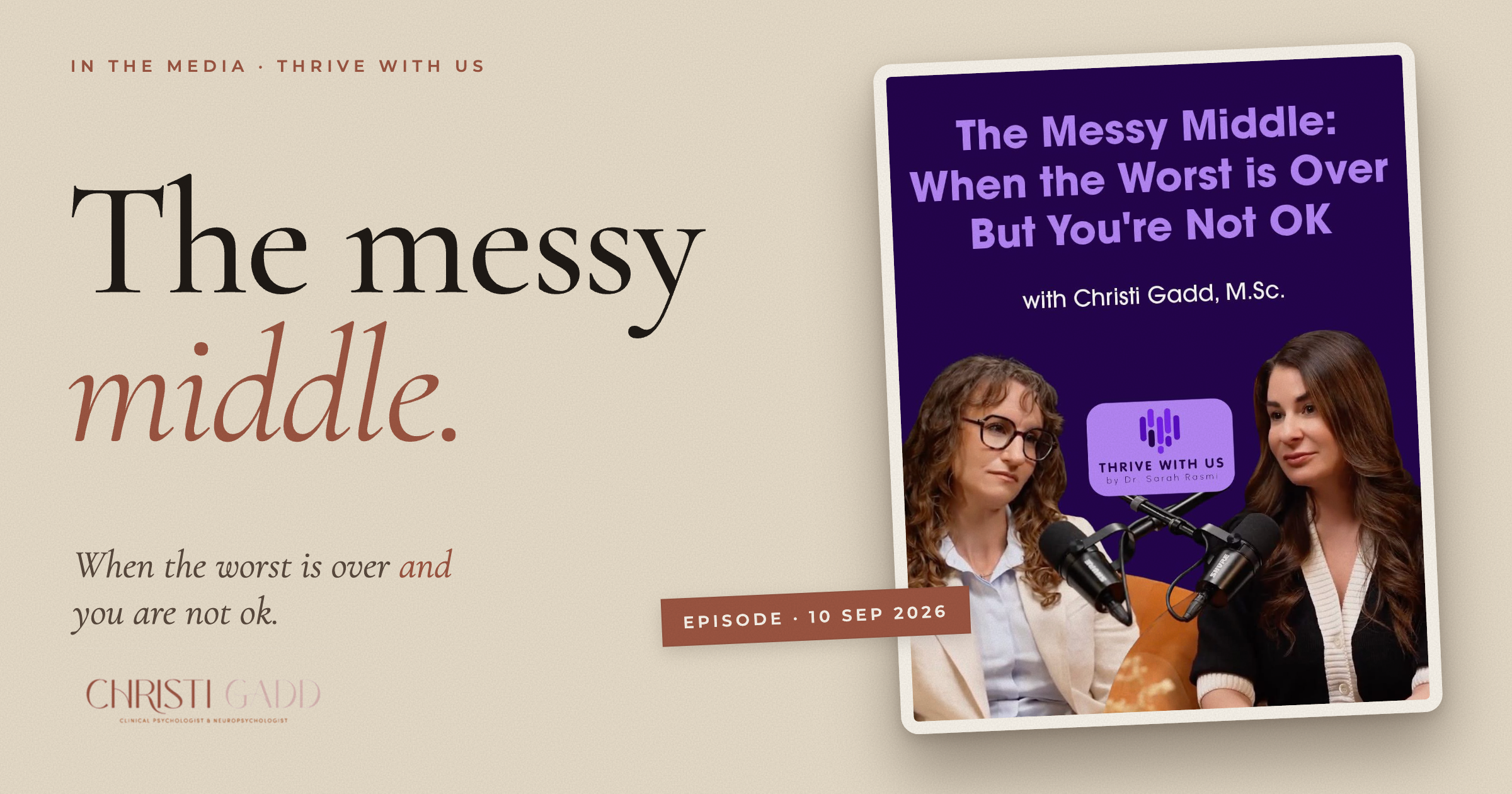

[…] If you would like more on this, my earlier post — built around a podcast conversation on adjusting to expat life in the UAE — is here: Adjusting to expat life in the UAE. […]
[…] wars and funerals. Becoming a mother — your whole life goes to pieces and you rebuild it again. Moving countries — same. A relationship ending. A job ending. In my work I sit with a lot of people whose lives […]