
The cups I drink my morning coffee from in Dubai were bought deliberately, to match…
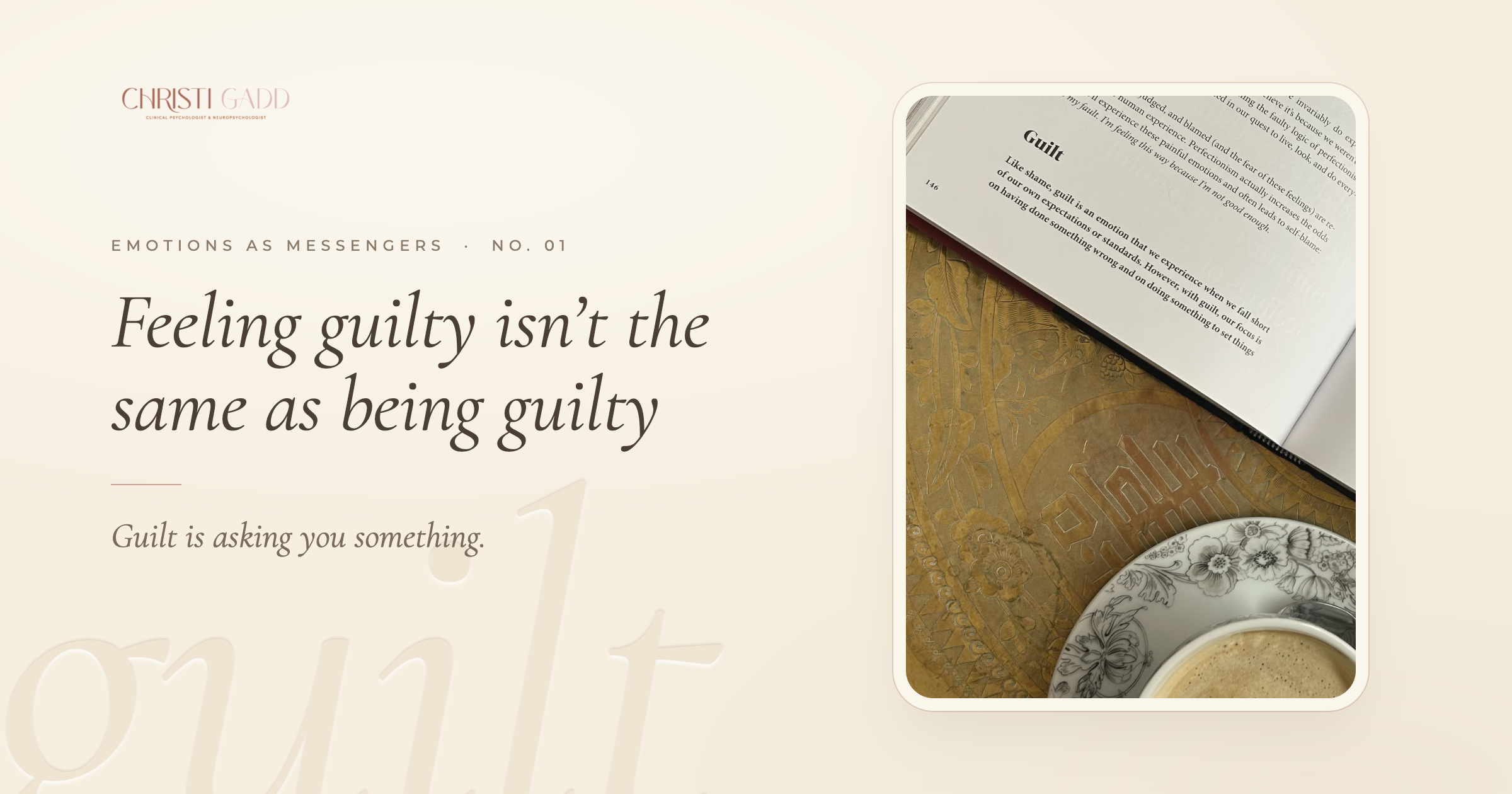
Feeling Guilty Isn’t the Same as Being Guilty
He is at home. He is completely fine. So why does one hour feel like something I have to explain?
A new mother sits at a small café table. There is a cup of coffee going cold in front of her, and a baby at home with someone who loves him. For the first time in weeks she is having a conversation that is not about feeds or sleep. Her friend is laughing. The coffee is good.
And underneath it, she feels guilty.
Nothing about this goes against what she values. Ask her outright whether a new mother is allowed an hour with a friend, and she would say of course she is. She would say it warmly to any other woman in her seat. Her own guilt, however, did not get the message.
I think about this gap a lot, partly because I have had my own version of it. When I moved countries, there was a quiet sense of — am I betraying something if I let myself adjust? If I let myself enjoy the beauty of it? Nothing had gone wrong. The guilt arrived anyway.
There is a smaller version of it I still catch myself in. I feel a little guilty calling myself an expat here, because almost everyone around me has made the same move and the landing was softer for it. Nobody is worse off for my having had it easier. The guilt turns up anyway.
Does feeling guilty mean you did something wrong?
Not necessarily. Feeling guilty is not the same as being guilty.
We tend to treat the feeling as the evidence, as though the discomfort has already settled the matter. But guilt is asking you something. It wants to know whether what you did lines up with what you value. That is the whole of its job, and the answering part belongs to you.
There is something in my first language I keep coming back to. In Afrikaans, skuld means debt. Skuldig means guilty, and it also means indebted — one word doing both jobs. German, Dutch and the Scandinavian languages all do the same. English does not quite: our word comes from an old one for an offence, and whether it was ever about owing is still argued.
But the older sense is how the feeling behaves. Guilt arrives like a bill. The only question worth asking is whether you owe anything.
So when guilt shows up, I think the honest first move is not to plead guilty. It is to ask what it came to say.
What is the difference between guilt and shame?
This is the distinction I most want people to have, because almost everything else follows from it.
Brené Brown defines guilt as “holding something we have done or failed to do up against our values and feeling psychological discomfort.” Shame she defines as “the intensely painful feeling or experience of believing that we are flawed and therefore unworthy of love and belonging.”
One is about something you did. The other is about who you are. June Tangney and her colleagues (2007) found the same split in the research: guilt keeps its attention on the action and tends to move people toward repair, while shame turns on the whole self and tends to move people toward hiding.
And this is where I would gently refuse the question. Am I a good person or a bad person? I think that is a trap, and a surprisingly popular one. What if you are just a person, trying to figure this out? The mother at that table does not need a ruling on her character. She needs to know what the feeling is for.
Why do you feel guilty for no reason?
Often there is no transgression underneath it at all, only a standard nobody could meet.
Research on maternal guilt by Miriam Liss and colleagues (2013) links it to self-discrepancy: the distance between the flawless, ever-present “good mother” a woman carries in her head and the ordinary, tired, human one drinking the coffee. That ideal mother has never been met by anybody. She does not exist, and she still somehow gets a seat at the table.
Paul Watzlawick had a name for this trap: the utopia syndrome. The further we fall short of an impossible picture, the more certain we become that something is wrong with us, when the thing worth questioning is the picture. Before you believe the guilt, it is worth asking whether the standard you are measuring against was ever a fair one.
Back at the small table, her phone is face down next to the cup. She has turned it over twice. Nothing had happened either time. She will turn it over again before the hour is out, and not because anything is wrong at home — but because a standard like that one wants proof, and there is never any to find.
Sometimes, of course, you look and the guilt is pointing at something real. A sharp word, a promise you let slip. That is guilt doing its actual work, and I will come back to it.
Can you change how guilty you feel?
To a degree, yes, because guilt is learned rather than fixed.
Susan David puts it that emotions are data, not directives. Guilt is information about what you value. It is not an instruction you are obliged to obey.
Marc Brackett, whose team at Yale built the How We Feel app, argues that precision is most of the work. Guilt and shame ask for opposite responses — one wants a repair or a looser standard, the other needs kindness — so naming the feeling accurately is not a nicety.
And Lisa Feldman Barrett helps explain why the same act can flood one person with guilt and leave another at peace. Feelings are built out of your history and the standards you were handed long before you had any say in them. What was assembled can be looked at again.
What to do when guilt shows up
Ask it one question: does this actually go against what I value?
There are three honest answers to that, and each one asks something different of you.
Sometimes the answer is yes. Then let the guilt point you toward repair. That is what it came for.
Sometimes the answer is no. Nothing went against your values. You are simply doing something you are not used to doing yet, and unfamiliar is not the same as harmful.
What if the answer is yes and no?
Sometimes it is. That is the one nobody warns you about. Yes and no at the same time. That usually means two things you value are bumping into each other, and neither of them is the one you should give up.
I value being there for my child. I also value being a person who still has friendships, and work, and an hour in the week that belongs to me. Both of those are mine. They just cannot both be fully honoured on the same afternoon.
When the answer is both, guilt is not asking you to choose a side. It is telling you that you are negotiating. That is uncomfortable work, and the discomfort is easy to mistake for evidence against yourself.
For those last two answers, the move I have found most useful is not to argue the guilt away. It is and. I talked about this with Dr Sarah Rasmi on the Thrive With Us podcast, and it is the word I keep coming back to.
I love my baby, and I needed this hour. I am grateful for this life, and I am tired inside it. Both are true at the same time, and you do not have to choose between them.
Sentences you can borrow
Some of these may fit:
“I love them, and I needed an hour that was mine.”
“Nothing went wrong here. I am just not used to this yet.”
“That is not my standard. It is one I picked up somewhere.”
And two questions to sit with, if you would rather reflect than rehearse. Whose voice is that standard in? And would you hold someone you love to it?
There is a thought I keep returning to, and it is not a comfortable one: perhaps I should be as kind to myself as I am to other people.
The mother finishing her coffee is not letting anyone down. She is doing the unglamorous work of staying whole enough to go home and love well.
I have come to think guilt is not proof you have failed. It is proof you care about how you relate to the people you love.
What if you check, and you are not proud of what you did?
Then the guilt is doing exactly what it came for. It has found the distance between what you did and what you value, and it is asking you to close it.
That is different work from the rest of this article, and it is a skill most of us were never taught. But the first move is the same one. You had to ask the question to find out.

Working with me
I am a Clinical Psychologist and Neuropsychologist. My clinical work is with couples and individuals, and I offer supervision to practitioners.
I see clients in Dubai at Thrive Wellbeing Centre in Jumeirah Lake Towers, and online for clients elsewhere.
Find me at Thrive Wellbeing Centre for bookings:
 https://www.thrive.ae
reception@thrive.ae
+971 56 895 2347
+971 4 514 7386
Related Posts


Comments (0)