
Esther Perel stel dit eenvoudig: "The quality of your life ultimately depends on the quality…
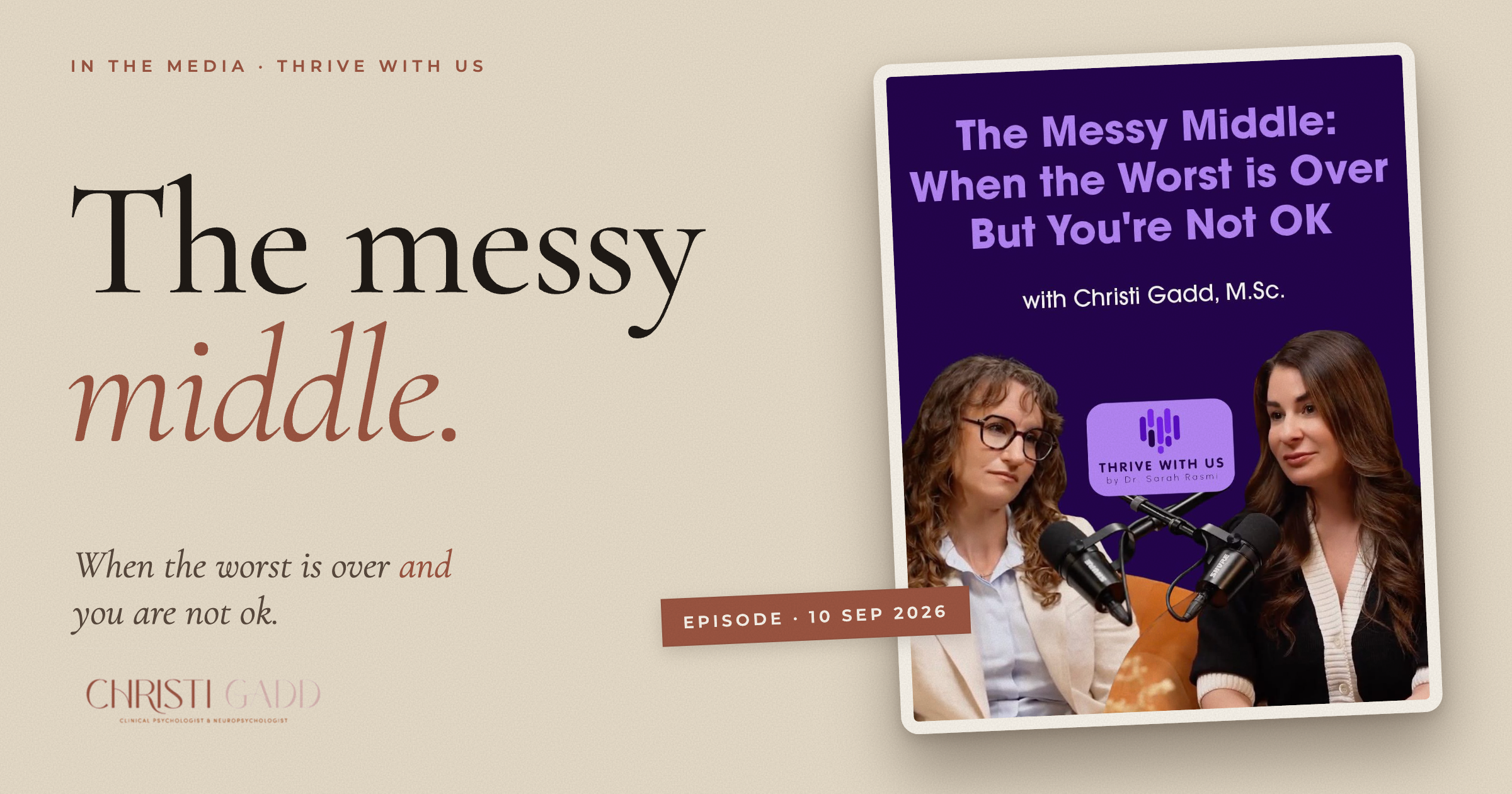
The messy middle: when the worst is over and you’re not OK
When someone dies, the freezer fills up. People arrive with lasagne and banana bread and more soup than anyone can eat. Then, a year later, you are still grieving and nobody brings anything, because the casseroles stopped long before the grief did.
That gap has a name. Brené Brown calls it the messy middle, and it is the part of my work I talk about most, because it is the part where almost everyone quietly decides they are doing it wrong.
I sat down with Dr Sarah Rasmi on the Thrive With Us podcast to talk about it. We recorded in Dubai in July, in a year that gave this city plenty of practice.
What is the messy middle?
Everyone talks about the crisis. Everyone celebrates the comeback. Very few people talk about what happens in between.
The messy middle is the stretch after the emergency has passed and before you feel like yourself again. The adrenaline has drained. The immediate danger is over. And you are still tired, still flat, still waiting for someone official to tell you that you are allowed to exhale.
It is not only wars and funerals. Becoming a mother — your whole life goes to pieces and you rebuild it again. Moving countries — same. A relationship ending. A job ending. In my work I sit with a lot of people whose lives came apart at a very ordinary-looking moment, on an ordinary Tuesday, and who are now several months into rebuilding and wondering why it is taking so long.
There is a shaking of your sense of reality in all of it. Things you knew for certain would never happen have happened. That is disorienting whether the thing was a catastrophe or a promotion.
Why does the messy middle feel lonelier than the crisis?
Because in a crisis, people rally. The phone calls, the messages, the checking in. If it is something happening to a whole city, you have the extra comfort of everyone around you being in it too.
Then it goes quiet. And silence is never neutral — it always carries a meaning, whether or not anyone intends one.
And what tends to arrive in the quiet is a question, usually kindly meant: why aren’t you over it yet?
Here is the loop that question sits inside, and it runs in both directions. The person in the middle pulls back because being asked feels like being assessed. The people around them read the pulling back as not trying, and ask a bit more pointedly. That lands harder, so there is more withdrawal. Nobody in that loop is being unkind. Everyone in it is getting a little further from what they wanted.
If you are on the receiving end of it, you are allowed to say plainly: I’m still in the messy middle. It’s a work in progress. And, if you have it in you: there’s no timeline on this.
Is there a timeline for healing?
No. And the absence of one is not a loophole either.
There is a real distinction between feeling your feelings and staying parked in them. The old line — accept what you cannot change, change what you can, and have the wisdom to tell the difference — is doing a lot of work here. Most of the frustration a support system feels comes from watching someone stall at the third part.
So the honest version is both: there is no deadline, and movement matters. Feeling and doing are not in competition. They take turns.
What actually helps in the messy middle?
I bring a lot of music into my therapy rooms, and one of the most useful frameworks I have found for this comes from a song. Jason Mraz wrote a track called 3 Things about what he does when his life falls apart. Three things, in order.
One: cry your eyes out
This is the part everyone wants to skip.
When my flight home to South Africa was cancelled — or rather postponed, for the third time — I sat on my balcony and cried my eyes out. The first time the alerts went off and none of us knew what to do, my legs were jelly. I have no qualms about saying so.
Emotions work something like the psyche’s immune system. The way the world inside you registers what is happening in the world outside you is by checking in with what you feel. Not a malfunction — information arriving.
Put in the language of software: a feature, not a bug.
Two: say thank you
I am openly biased towards gratitude, and I learned it from my grandmother, who was delighted by a single flower picked out of the garden.
Gratitude is not the same thing as what gets called toxic positivity, and the difference is worth being precise about. Toxic positivity says look at everything you have, what are you complaining about. Gratitude says this is hard, and there is also a flower. One cancels the complaint. The other lets it stand.
Every cloud has a silver lining. Which also means every silver lining comes attached to a cloud.
Three: take charge
Rebuilding is not instant and it is not tidy. It costs effort and it involves loss. It is also possible.
Start with the basics, which are almost embarrassingly plain:
Are you eating? Are you sleeping? Are you moving?
I would add a fourth. Are you feeling? When I notice myself switching off emotionally, that is my signal that something needs a reset.
How do you know when you are numbing?
A colleague described it as screen-saver mode: you are in the room, you are technically present, and you are not really there. It is the email you need to write and instead you scroll up, scroll down, scroll up, scroll down.
Most of what we numb with is dual-use. Food can numb or it can nourish. Exercise can numb or it can restore. Work is the difficult one, because work is the numbing strategy that people high-five you for.
Coming out of a crisis, work and exercise keep the adrenaline running if nobody is watching the dial. The question I use on myself: is this email important, or is it a crisis? If everything in a week has been sorted into the crisis pile, that is worth noticing.
And some of it is fine. When I was feeling most out of control, I took out my label maker and labelled my entire kitchen. It changed nothing about the world. It made opening a cupboard feel manageable. I also got a great deal of a friend’s blanket crocheted that month, at a slightly frantic tempo.
The useful question is not should I be doing this, but: is this soothing me, or is this rebuilding me? Both are allowed. Knowing which one you are doing is the whole skill.
What is the power of “and”?
This is the piece I would keep if I could only keep one.
People in the middle of something hard often believe they are not allowed the good bits. My partner just died — how can I laugh? I’ve just moved here — am I betraying home if I let myself love it?
The word that answers this is and.
I am stressed and worried and scared, and I trust that I am taken care of. I am grieving a loss that will not shrink, and I am grateful for what it left me. I love my new baby and this small family I have made, and I am exhausted and frustrated and not entirely sure who I am.
Both. Not one at the expense of the other.
I wrote something very short in 2017, on the day I closed my office door at 1 Military Hospital for the last time — sadness and loss for what I was leaving, and excitement for what came next, in the same breath. I did not have the word for it then. It was the and.
This is the same shape as the glamour and the grief of moving countries — not one feeling giving way to the other, but both running at once.
It feels awkward the first few times. You can be deeply grateful to be safe and still annoyed that your table at the restaurant was taken. The gratitude does not disqualify the annoyance, and the annoyance does not cancel the gratitude.
Why does nuance matter so much?
Because being human is not a multiple-choice question.
I watched Esther Perel answer a version of if you ran the world, what one rule would you make — and her answer was that nobody should be allowed to state an opinion in absolute terms. You would have to attach a percentage. Hold the complexity in the sentence.
We reach for certainty because it saves energy. Pick a lane, pick a side, cut the noise. It is genuinely cheaper. It also narrows what you are able to enjoy, and it makes the people who see things differently into a category rather than people.
Even the question am I a good person or a bad person runs into this. If I am good, then everyone unlike me is bad. If I am bad — well, then what?
What if you are just a person, working it out? What if life is not a problem to be solved or a mountain to conquer, but a dilemma to negotiate — one where at this stage the answer is one thing, and at the next stage it is another?
When does it end?
Normal is a setting on a washing machine.
This part of your life may go back to something that resembles normal. You will also, at some point, meet the next thing, because that is how lives go. Nothing has to be resolved for you to be fully a person in the meantime.
My philosophy, if it helps: keep moving. One foot in front of the other, towards whatever currently carries meaning for you. Pivot when you need to. Small steps count, and in the messy middle they are usually the size that is available.
Technically, life is one long messy middle. We just get some highs and some lows along the way.
Listen to the full conversation
The Messy Middle: When the Worst is Over But You’re Not OK — Christi Gadd in conversation with Dr Sarah Rasmi on the Thrive With Us podcast. Watch on YouTube · Also on Spotify and Apple Podcasts.

Working with me
I am a Clinical Psychologist and Neuropsychologist. My clinical work is with couples and individuals, and I offer supervision to practitioners.
I see clients in Dubai at Thrive Wellbeing Centre in Jumeirah Lake Towers, and online for clients elsewhere.
Find me at Thrive Wellbeing Centre for bookings:
 https://www.thrive.ae
reception@thrive.ae
+971 56 895 2347
+971 4 514 7386
Related Posts

Comments (0)