
When someone dies, the freezer fills up. People arrive with lasagne and banana bread and…
Grounded Fears: Understanding and Addressing the Fear of Flying
Living in the UAE means flying often — for work, to see family, to get away. For most people, it is simply an ordinary part of life. For others, though, a fear of flying takes hold. The anxiety can begin days before take-off and stay until the wheels are back on the ground.
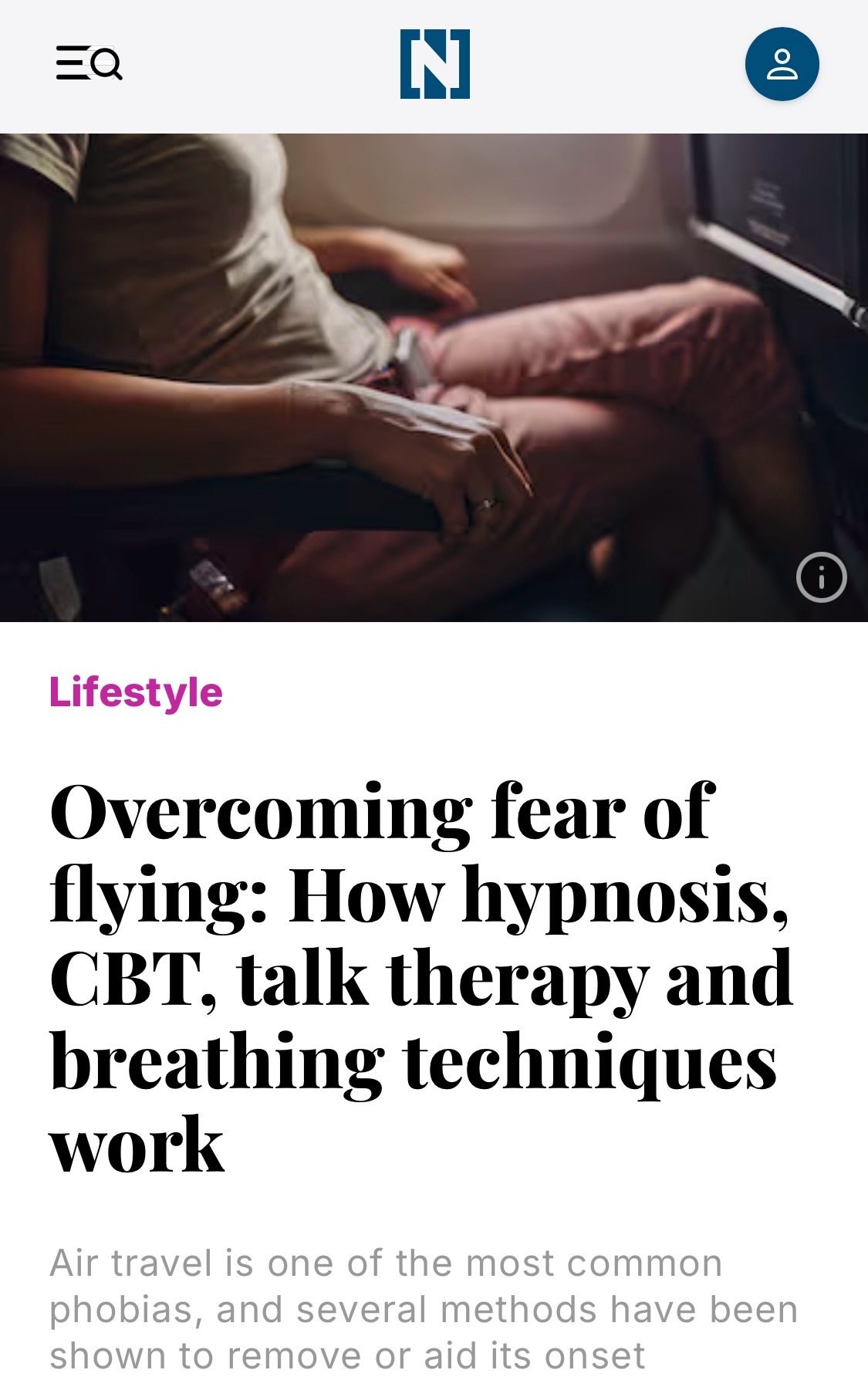
I recently contributed to a feature in The National on overcoming the fear of flying, alongside several other practitioners. As usually happens with a feature, only part of what I shared made it into print. It is a subject close to my work, because for several years, aviation psychology was a central part of what I did. That work included psychological and cognitive assessments of pilots and aircrew. So here is a fuller exploration of what the fear of flying is, and what genuinely helps.
What kind of fear is it?
Fear of flying — which clinicians call aviophobia, or sometimes aerophobia — is more common than most people realise. In practice, clinicians use the two terms interchangeably. Aerophobia does carry an older, separate meaning in some contexts — a fear of fresh air or draughts — but here both simply mean a fear of flying.
In clinical terms, aviophobia falls under the diagnosis of a specific phobia. More precisely, it sits within what the DSM-5-TR calls the situational subtype. That is the same group that holds fears of enclosed spaces, like lifts and tunnels. It usually brings intense, persistent fear, along with avoidance. For a clinician to call it a phobia, the fear generally needs to have lasted six months or more. That duration is part of what separates a phobia from ordinary nervousness. As a result, it can cause real disruption when air travel is hard to avoid for work or family.
Is it ever just about flying?
Yes — and no. For some people, the fear is fairly contained and practical. It centres on turbulence, on the aircraft failing, or on being in an enclosed space with no easy way out.
This kind of fear often has a clear origin. For instance, it might trace back to one bad flight, or to distressing news coverage. Sometimes, too, it is simply the reality of not being in control. And sometimes it forms more quietly, through what we call vicarious learning — absorbing fear secondhand from someone else’s account of a frightening experience.
For other people, however, a fear of flying is more symbolic. The aeroplane becomes a stand-in for something deeper. It can carry:
- a fear of losing control — flying asks you to hand control to pilots and technology, and that can echo a deeper struggle with control elsewhere in life;
- separation anxiety — a fear of being far from the people you love;
- claustrophobia, or a fear of being trapped — the enclosed cabin can bring that to the surface;
- panic or health anxiety — for someone with a history of panic, the fear of panicking mid-flight, with no way out, can become the centre of it;
- existential fears — to do with mortality, or with helplessness.
In these cases, the aeroplane becomes the stage on which a deeper fear plays out. Knowing which of these you are dealing with therefore changes what the work needs to be.
How do therapists work with a fear of flying?
The first thing I want to understand with anyone who comes to me is one question. Are we working with a fear that is contained, or one that is more complex? A careful conversation helps with that. It looks not only at the experience of flying, but also at the wider emotional landscape of a person’s life.
From there, the work tends to follow a few broad steps. First, it begins by clarifying the nature of the fear. Is it limited to flying, or part of a broader anxiety? Then comes some psychoeducation: understanding how phobias form, and why avoiding the feared thing tends to make them stronger. Next, talk therapy explores what sits underneath — themes like control, safety, attachment, and past hurt. Alongside this, we build skills: practical ways to manage anxiety as it rises.
The part most people picture is exposure therapy. This means meeting the feared situation gently and gradually, rather than all at once. It might begin with imagery, then move through virtual simulations, and finally build towards an actual flight. The pace follows your readiness, and I never push it further. Where trauma or panic disorder is part of the picture, we may also draw on further approaches. EMDR can help where a discrete traumatic memory underlies the fear, and interoceptive exposure can help with panic.
Importantly, none of this is about arguing you out of your fear. Instead, it is about giving you enough new, manageable experience that the fear slowly loosens its hold.
What practical tools can help?
Therapy is not only about insight — it is also about action. Much of the work, therefore, is equipping people with calming strategies they can use on their own. They help both before a flight and during one. These often include:
- cognitive reframing — noticing catastrophic thoughts and meeting them with something more realistic;
- breathwork — slow, deep, diaphragmatic breathing that helps the body settle;
- progressive muscle relaxation — releasing physical tension to interrupt the spiral of anxiety;
- grounding techniques — using the senses to stay in the present, such as the 5-4-3-2-1 exercise;
- mindfulness — letting anxiety be present without panicking about its presence.
It can also help to practise graded exposure outside of sessions. For example, that might mean watching flight documentaries, visiting an airport, or even sitting in a stationary aircraft. Some airlines run flight-anxiety programmes too. These combine psychological support, education about how flying actually works, and gradual exposure — sometimes including an accompanied flight.
For a fear that is strictly limited to flying, a consultation with a psychiatrist can be worth considering. Medication is generally an adjunct to therapy, though, rather than a substitute for it. Not every sedative suits flying, either. So this is very much a decision to make with the prescriber.
A fear of flying might grow from a single frightening flight. Equally, it might tie into something broader. Either way, it is both understandable and workable. Fear rarely responds to statistics alone, and telling someone to calm down has never helped anyone. But with steady, well-paced support, the fear can loosen — until flying becomes possible again, and sometimes even ordinary.
How to book with me
Fear of flying, and anxiety more broadly, is part of what I work with — alongside couples and individual therapy. I see clients in Dubai through Thrive Wellbeing Centre in JLT, and online for people based elsewhere. So if something in this piece resonated, you are welcome to get in touch.

Find me at Thrive Wellbeing Centre for bookings:
 https://www.thrive.ae
reception@thrive.ae
+971 56 895 2347
+971 4 514 7386
Related Posts


Comments (0)